
Public signals
Vivary tracks a small public metrics snapshot so the README and site can show real distribution signals without a private analytics dashboard.
Current sources
Section titled “Current sources”| Signal | Source | Notes |
|---|---|---|
| npm weekly downloads | https://api.npmjs.org/downloads/point/last-week/%40vivary%2Fcreate and https://api.npmjs.org/versions/%40vivary%2Fcreate/last-week |
Public weekly and per-version downloads for @vivary/create. |
| PyPI weekly downloads | https://pypistats.org/api/packages/<package>/recent |
Public recent downloads for create-vivary, vivary-tropo, vivary-ozone, and vivary-exo. PyPI stats can lag, rate-limit, and filter mirrors/bots. |
| GitHub repo signals | https://api.github.com/repos/vivary-dev/vivary |
Public repository stars, forks, issues, and pushed time. |
The latest checked-in values live in stats/latest.json. The
history lives in stats/history.csv.
Workflow
Section titled “Workflow”.github/workflows/track-stats.yml runs daily and on manual dispatch. It calls
tools/update_stats.py, which updates:
stats/latest.jsonstats/history.csvstats/usage-snapshot.svgsite/public/usage-snapshot.svg
The workflow opens a PR against dev; it does not write directly to dev or prod.
If the normal daily stats branch already exists, the workflow creates a unique branch
for that run instead of force-pushing over it.
The updater authenticates only requests to api.github.com with the workflow’s
short-lived repository token. That credential is never forwarded to npm or PyPI.
Transient registry failures use bounded exponential retry and honor numeric
Retry-After values up to 30 seconds. If a source fails but a previous value exists,
the snapshot is marked stale and records the warning in stats/latest.json and
stats/history.csv. If a source fails with no previous value, the workflow fails
instead of writing fake zeroes.
Every generated snapshot remains inspectable in a PR and receives an exact-head CI
dispatch. Because a PR created with the repository token otherwise receives
approval-required checks, the workflow explicitly dispatches ci.yml against the
stats branch. CI verifies the named PR’s live head and base SHAs before running the
normal tests, graph review, and conditional site build. Only an ok, warning-free,
non-stale snapshot receives automated-current and enables auto-merge. A stale
snapshot receives blocked, remains open without auto-merge, and cannot supersede an
older healthy proposal.
The daily steward checks more than age: the checked-in snapshot must be fresh, ok,
warning-free, and free of nested stale-source flags. Every open PR must also carry
exactly one lifecycle label defined in
Contributing.
Automated proposals with a merge conflict or failing check remain findings and must be
reclassified blocked. Serialized healthy stats runs may close only older stats PRs,
with a replacement receipt; branch deletion remains a separate destructive gate.
How to read the chart
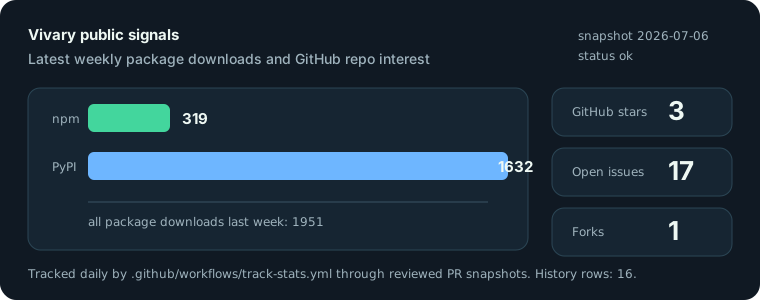
Section titled “How to read the chart”This is an early open-source project signal, not product analytics. Use it to see whether the distribution surfaces are alive and whether the trend is moving; do not over-interpret one row or compare npm and PyPI numbers as if the registries count the same way.
The SVG chart size is fixed (760x300). The npm and PyPI bars are proportional to
the larger of the two weekly counts in that snapshot, so a bar can shrink even when
the total package download number rises. That is a data-scale change, not a badge or
container resize.