

Small seed · earned context · human gates
Give agents governed context without the file pack.
Greenfield Core creates five operational files and no starter second brain. Brownfield adoption stays capped and review-first. MCP reads and supplies capsules; a separate exact-hash transaction writes one earned record.
uvx create-vivary init my-workspace --preset coding --no-wizardPublished 0.4.2 on PyPI and npm, verified from the public registries on 2026-08-15. See the release workflow for how that status is set.
- Exactly five seed files
- No starter records
- Local-first + MIT
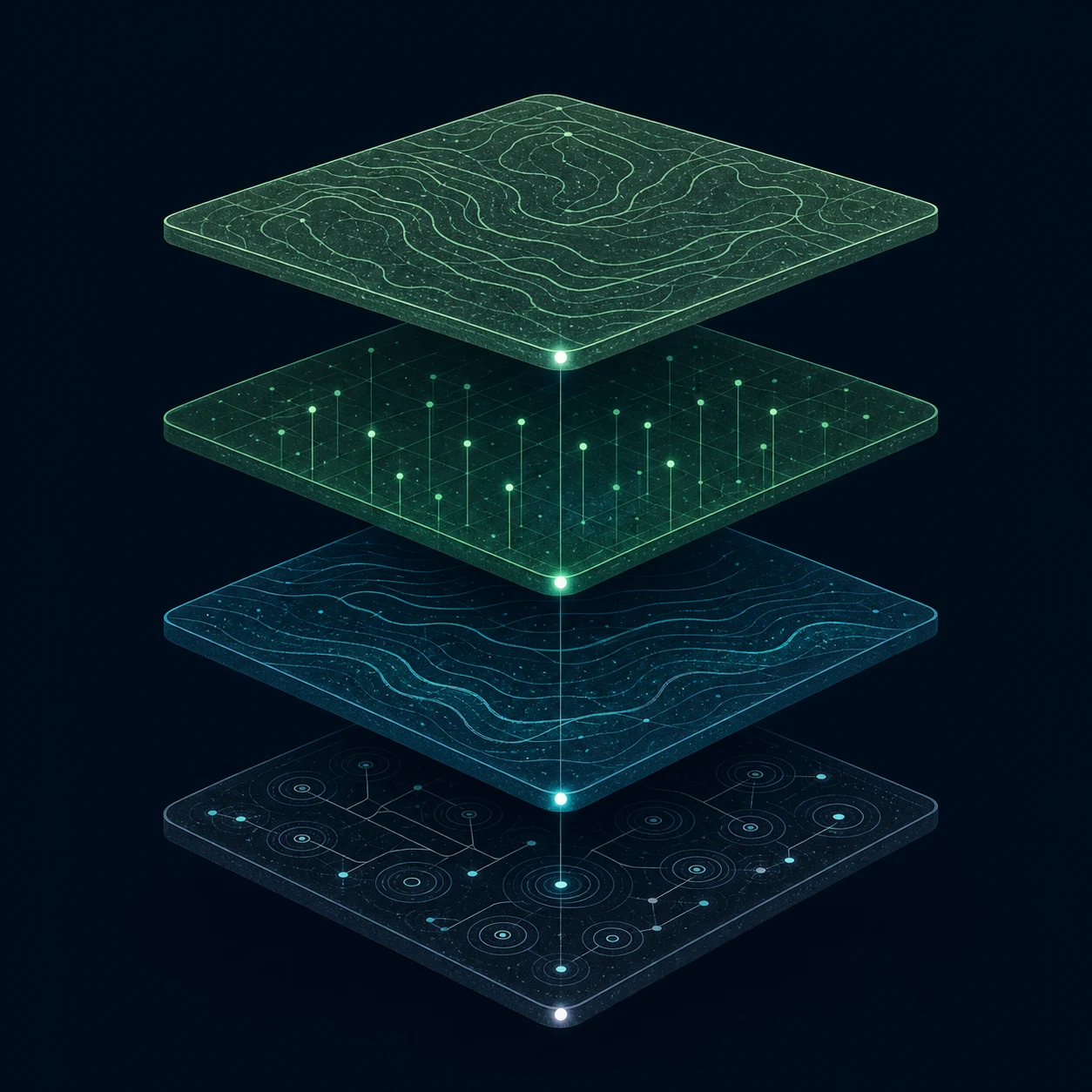
One world. Four layers.
A small atmosphere for long-running work.
- The substrate
tropo
A typed knowledge graph for what the workspace knows, where truth lives, and what depends on it.
- The operating layer
strato
One visible state surface, private boundaries, and a governed loop that grows only when real work earns context.
- The protective filter
ozone
Graph-aware review and human gates for changes that are durable, destructive, or outward-facing.
- The coordination layer
exo
Claims, conflicts, and role contracts for the moment one agent becomes many.
The product thesis
Agents do better work when context is small, typed, and earned.
Pre-populated workspaces invent truth and consume the context they were meant to protect. Vivary starts with one bounded context capsule and one visible state surface. Real records arrive through verified work and a deliberate write gate.
Brownfield without takeover
Adopt the project you already have.
The adoption path is deliberately read-first, bounded, and exact-hash gated. Existing project structure stays in charge.
- 01
Map the terrain
tropo map --root .Read a large repo, vault, or docs tree without opening everything. No config and no writes.
- 02
Adopt without wrecking it
create-vivary adopt . --jsonPreview the exact hash first: at most three payload files and two bounded host integrations.
- 03
Keep it healthy
create-vivary doctor .Verify the thin contract and privacy boundary without writing runtime trend state.
One front door covers the common work. The vivary meta package routes ten task verbs to these commands: create,adopt, doctor, capabilities,check, find, decide,review, impact, and control. Those verbs ship in vivary 0.2.0 and are not yet on PyPI. The standalone commands stay the advanced surface with every operation. See thecommand reference.
Proof before promise
The claim is measurable.
Vivary should reduce the tokens and wrong-file opens an agent spends finding project truth. The roadmap prioritizes a rerunnable benchmark, brownfield proof, retention through doctor, and honest public signals.
Quick answers
Before you bring it into a real project.
The short version of what Vivary is, what it touches, and where the current evidence stops.
What is Vivary?
Vivary is a local-first governed-context standard and scaffolder. Core starts with five small files: one context capsule, one visible state surface, policy, startup routing, and private/runtime ignores.
Can I use it with an existing project?
Yes. Brownfield adoption starts with a deterministic dry-run, adds at most three Vivary payload files, and touches only bounded generated blocks in AGENTS.md and .gitignore after exact-hash approval.
Is Vivary an AI agent or model?
No. Vivary is the workspace structure around your agents. It works with tools such as Claude Code and Codex without replacing the agent, editor, model, Git, or issue tracker you already use.
Does it upload or index my files?
Not by default. Core is local and dependency-light. Optional MCP is local stdio and read-only; networked providers and semantic indexing require separate installation and approval.
Am I locked into Vivary?
No. Project truth stays in Markdown, YAML, and ordinary folders. You can inspect it, version it with Git, edit it anywhere, and remove the Vivary tooling without trapping your work in a hosted platform.
Is it open source and production-ready?
Vivary is MIT licensed. The five-file 0.4.2 scaffolder, the governed roles, and the optional MCP adapter are published on PyPI and npm, and each version was verified from the public registries on 2026-08-15. Vivary is pre-1.0, so treat it as production-ready for local governed context and read the release status before you pin a version.
The deeper argument
Why agent workspaces need a standard.
The white paper defines the system invariants, architecture, threat model, human-gate protocol, evidence ledger, and benchmark that keep Vivary's claims falsifiable.